



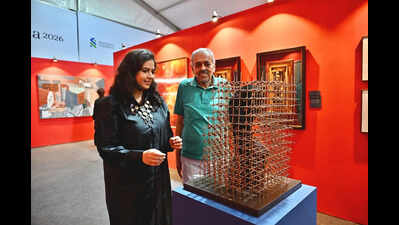
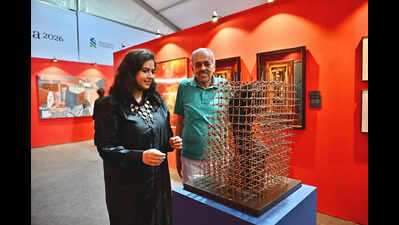
Bin there, made thatFor the Art of India launch, on the grounds of CSMVS on March 21, Bandana Jain wore her manifesto around her neck—a statement neckpiece of old watch dials that reflected her eye for beauty in the discarded. “It resonates with my thinking; it shows that scrap, too, can be turned into something beautiful,” says the artist. Nearby is her own work of transfiguration—a human head sculpted from discarded cardboard packaging, seemingly entrapped, but actually encased, in a finely crafted scaffold of brass tubes and copper wires. “I am talking about the human struggle and how one can overcome it if one is determined. The figure inside the scaffolding is going through a process of healing.” The found art sculpture was born of the confinement of Covid and the anxiety it triggered. But confinement can also be a time to reflect and rebuild the self, she observes. Jain’s artistic practice is grounded in a similar soil of possibility. It’s what draws her to discarded material like cardboard packaging. “I considered it a great way to create a dialogue around sustainable practices. Plus, cardboard has a nice grainy texture. It may be waste for you, but it’s treasure for me.” She begins by taking an old carton apart and then cutting each plane and stacking them up one by one, rejoining multiple pieces laboriously to assemble a composite figure. Each sculpture can be a three-month long ‘meditative practice’. Locked In, another found-object installation by the Jaipur-based collective Wolf—founded by Ritu and Surya Singh—emerges from similar environmental concerns and an engagement with waste as resource. Crafted from industrial scrap metal mesh, the piece reimagines a Mughal-Rajput charbagh, where a dense cluster of hard-petalled poppies and larkspur takes root—perhaps an elegy to what’s being lost, and a foretelling of what’s to come.