



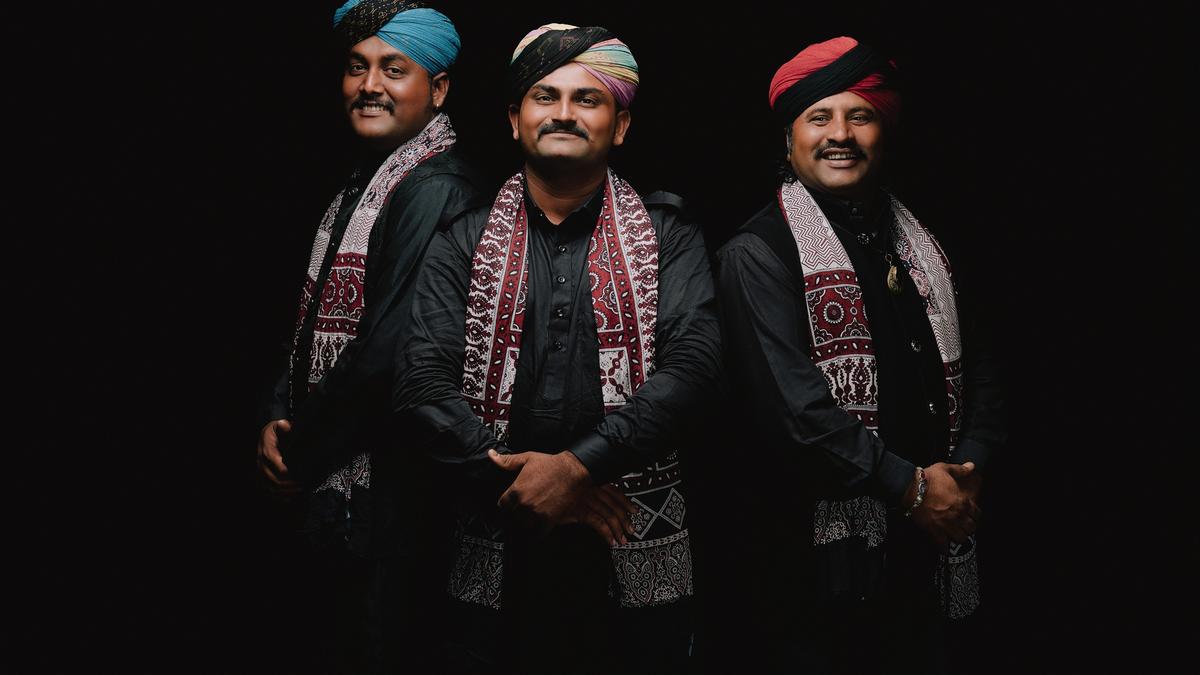
Barmer Boys—Bhura Khan, Magada Khan and Sawai Khan
| Photo Credit: Special Arrangement
When the Barmer Boys, who belong to the Manganiyar Sufi Muslims community from Rajasthan, take the stage, the venue hardly matters. The moment they launch into Rajasthan’s Manganiyar music, blending folk and Sufi sounds with beatboxing, the energy shifts instantly. They performed recently at Windmills Craftworks in Hyderabad.
The trio comprises Bhura Khan—nephew of legendary sarangi maestro Lakha Khan—Magada Khan on dholak, and Sawai Khan, a multi-instrumentalist who plays the morchang, bhapang and khartal, while also beatboxing. Performing in Hyderabad last week at Windmills, they proved that music transcends boundaries. The set moved fluidly from a soulful kalaam (a form of devotional poetry and music) to a Krishna bhajan, then songs of love and longing, before closing with an electrifying jam session powered by beatboxing.
For over 14 years, the Barmer Boys have performed at over 250 concerts across 25 countries. For them, travelling and sharing the flavour of folk music is the greatest reward. “Our Indian folk music is so well appreciated abroad,” says Bhura Khan. “It reminds us that music has no barriers. Audiences, no matter where we perform, instinctively know which songs to dance to. That surprises us every time.”
The band traces its origins to a recording session with folk singer Luqma Bai. Their manager, Ashutosh, noticed Manga—their former lead singer—on the harmonium. After recording Luqma Bai, Manga suggested Ashutosh record his vocals too. Impressed, Ashutosh decided to form a band around him. It took time to find the right members, but the group was eventually launched at the Desert Festival in 2011. They still did not have a name. Ashutosh wanted something that would work at clubs and festivals, yet stay rooted in their identity. They returned to their origins—Barmer.
Their approach to music is clear: not to frame it as a fading tradition. “This art is alive and kicking, and that’s how we want audiences to experience it,” says Sawai Khan.
Practice, for them, is constant. “When we’re not travelling, we’re on riyaaz. When we work on new pieces, we rehearse together. The rest comes from years of playing with each other,” says Sawai. He also taught himself beatboxing through YouTube. “When I first saw beatbox artists, I was fascinated. I just kept learning on my own,” he adds.
Published – March 24, 2026 09:46 am IST