




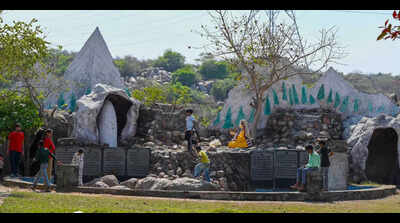
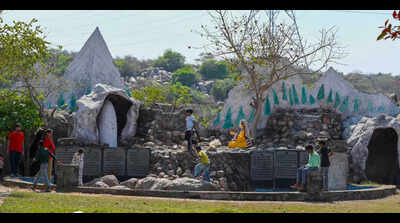
New Delhi: Far from the Valley they call home, nearly 4,000 Kashmiri Pandits spent Sunday climbing hundreds of steps to reach atop a hillock in Anangpur village, Faridabad, where a replica of Srinagar’s sacred Hari Parbat stands.They gathered near Mata Sharika Temple not only to mark the new year, but to keep a fading inheritance alive. For a community long separated from its homeland, Navreh, the Kashmiri new year, is an effort to ensure that what was left behind is not lost.The morning of Navreh begins with a quiet ritual, as families gather to gaze into thalis carefully arranged with rice, fruits, flowers, salt, a book, pen, ink pot, traditional bread, a mirror, and a painting or image of their deity. This practice is known as thal-barun, or the filling of a thali, and thal vucchun, or the viewing of it.According to tradition, people would then cook yellow rice, known as taher in Kashmiri, fill their samovars with kehwa and spend the day on the slopes of Hari Parbat. Munching traditional snacks like nader monj, or fried lotus stem, and water chestnuts, known as gaer, they would witness the day unfold with songs in praise of Sharika Devi and a shared sense of joy at the arrival of a new year.Cut to the present. The same spirit now finds expression in a day-long cultural gathering organised each year by Kashmiri Sewak Samaj in Faridabad. The quiet of the morning gives way to music, as young voices are heard in song and guitars blend seamlessly with tradition.“There is a concerted effort to keep Gen Z connected to their roots. The performers are generally young, and the platform is theirs,” said Sudhir K Sopory, president of Kashmiri Sewak Samaj and former vice-chancellor of JNU.Traditional Kashmiri music remains at the heart of the celebration, but it is the younger generation that takes centre stage. The lyrics endure, even as the sarangi gives way to the guitar and the tumbaknaer to drums. The pitch is livelier, and while chhakri (folk music) continues to be popular, it is often reimagined through rock and fusion.“This has been organised since 1997. Of course, the scale of the event has changed. People start arriving early in the morning and keep coming through the day. It is a celebration with performances, food, and a space for the community to come together,” said Amal Magazine, a member of the Samaj.For many young Kashmiri Pandits in NCR-Delhi, this is the only Navreh they have known. Born far from the Valley, their understanding of Kashmir is often pieced together through stories, songs and rituals passed down at home. On this day, these fragments come alive in a tangible way.Kamakshi Bhan (21), said, “I grew up attending this event, and now I’m contributing as part of the youth”. Another participant, Simran Bhat, said, “Our culture feels like it is fading, so it is up to the younger generation to keep it alive. Social media is helping, with more Kashmiri singers and dancers emerging.”Reflecting on how the platform has evolved over the years, Sanjeev Raina Gautam, mentor and a chhakri performer, said, “We began about 11 years ago with a Kashmiri language talent hunt, which was challenging since many children were born and raised here. Today, we have a strong group of young performers.”Among those taking the stage are young participants rediscovering their roots in their own ways. Sharika said, “I’m performing Bharatanatyam today. Events like these help me connect with my culture — from food to attire.”For others, the connection has been shaped within the home. Vanshika said, “I started learning classical music in Class III and trained for five years. I was born in Jammu but grew up in NCR. Whatever Kashmiri I know is because of my family.”Food, as always, anchors memory. Stalls on sunday offered a full Kashmiri spread through food partner MYFOJO as the fragrance of kehwa mingled with the aroma of festive dishes. Conversations drifted easily between elders recalling celebrations at the foothills of Hari Parbat and children experiencing their own version of it here.To understand the depth of this day, one must return to its origins. Navreh, in Kashmiri, means ‘new flame’ or ‘new spark’, a metaphor for renewal. It is believed that on this day in 3,076 BC, the first rays of the sun touched the sacred shrichakra atop the hill at Hari Parbat in Srinagar.The hill is revered as the abode of Goddess Sharika or Haer as she is lovingly called. She is considered the primal mother deity in Kashmiri belief. Countless folk songs celebrate her, often depicting her as a bird watching over the land and its people. Kashmiri Pandits follow the Saptrishi Samvat calendar; this Navreh marked the transition from the year 5,101 to 5,102.